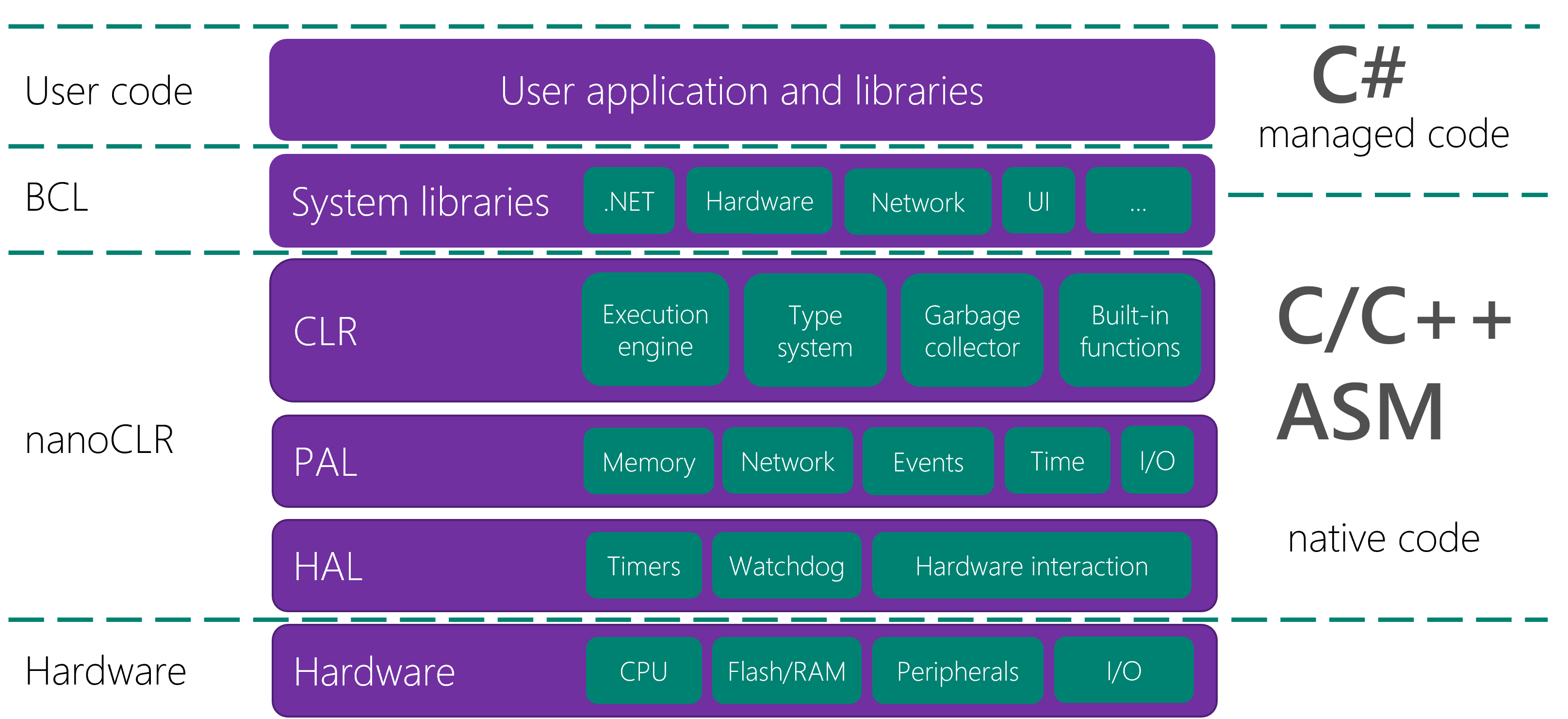
https://nanoframework.net/partner-program/chibios/
they have reference board at STMicroelectronics and Espressif
https://docs.nanoframework.net/content/reference-targets/stm32f769i-discovery.html
https://docs.nanoframework.net/content/community-targets/index.html
peripherals:
https://docs.nanoframework.net/devicesdetails/README.html
https://www.youtube.com/playlist?list=PL1ljc761XCiYVaDEfS4X-f493capyL-cL
The interpreter adds latency, and the Garbage Collector (GC) can introduce non-deterministic “stop-the-world” pauses. For a traffic control algorithm:
Critical Timing: If you need microsecond-precision response, you should handle that specific part in a “Native Interop” (writing that small piece in C and calling it from C#).
Custom Design: Since you want to design your own board, .NET nanoFramework is your best bet. You can take their reference implementation for the STM32F4/F7, map your pins in the C++ bootloader code, and flash it. There are no per-unit royalties.
| Feature | Bare Metal C | .NET nanoFramework |
|---|---|---|
| Execution | Direct Machine Code | Interpreted IL |
| Memory Mgmt | Manual (malloc/free) | Automatic (Garbage Collector) |
| Development | High Complexity | Fast (Visual Studio / C#) |
| Real-time | Hard Deterministic | Soft Real-time |
| Debugging | GDB / JTAG | Visual Studio (USB/Serial) |
- Can run on resource-constrained devices with as low as 256kB of flash and 64kB of RAM.